

Rebalance your portfolio with new deposits, without selling everything
One day you decided to put half of your portfolio in ETFs, a quarter in shares, and the rest in bonds, gold or cash. A few years later the actual split looks quite different: what rose most weighs more, what stalled weighs less, and your deposits didn't always follow the plan.
Rebalancing means bringing the portfolio back towards the allocation you chose. The aim is to keep the strategy and the level of risk you set for yourself, whatever markets and your investments do. This guide explains how to measure the gaps and how to close them without necessarily selling.
The figures come from Finapic's fictional demo portfolio, all accounts together: they illustrate a method, not an allocation to copy.
Why a portfolio drifts
Each asset class moves at its own pace. Over the period, in the fictional portfolio, crypto rose about 28%, gold 18%, shares and ETFs 14%, bonds 7% and cash 2%. The weights change mechanically, even if you touch nothing.
Your own decisions add to it: a bigger share purchase one month, a savings account topped up at the start of the year, a sale. After a few years the gap with the planned allocation can reach several points on one class.
That isn't a problem in itself. But the allocation you chose matched a level of risk: if your portfolio drifts towards the asset classes that rose most, its exposure to risk can change without you really deciding it. You can end up with a portfolio different from the one you first chose.
Rebalancing lets you correct these gaps gradually and stay true to your target allocation.
Set targets and measure the gaps
The first step is to write down your target allocation, as a percentage of the portfolio's value. The total must be 100%. For each class, the gap reads two ways:
- In percentage points: target weight minus actual weight (target 50%, actual 44%: 6 points behind).
- In euros: what you would need to add or remove to be exactly on target, with the total value unchanged.
The two complement each other: the gap in points shows which classes are furthest from their target, while the gap in euros estimates the amounts to reallocate.
Here is the fictional portfolio (€93,641 in all) against its targets:
| Asset class | Value | Actual weight | Target weight | Gap |
|---|---|---|---|---|
| ETF | €41,012 | 44% | 50% | +€5,808 (+6.2 pts) |
| Stocks | €27,076 | 29% | 25% | −€3,665 (−3.9 pts) |
| Cash | €10,500 | 11% | 8% | −€3,009 (−3.2 pts) |
| Bonds | €8,840 | 9.4% | 8% | −€1,349 (−1.4 pts) |
| Crypto | €3,255 | 3.5% | 4% | +€490 (+0.5 pt) |
| Gold | €2,957 | 3.2% | 5% | +€1,725 (+1.8 pts) |
A positive gap means the class is behind its target; a negative gap, that it is above. Here ETFs, gold and crypto are behind; stocks, cash and bonds are above.
For instance, ETFs make up 44% of the portfolio, while your goal is 50%. About 6 points are missing to reach the target, that is €5,808 with the total value unchanged.
Two ways to rebalance
There are two main approaches to bring a portfolio back towards its target allocation: sell the assets above their target to buy those behind, or use new deposits to close the gaps gradually.
Sell what is above, buy what is missing
This is full rebalancing: every class goes back to its target at once. In the example you would sell €8,023 (stocks, cash, bonds) and buy as much (ETFs, gold, crypto).
It's quick and exact, but a sale has a cost: brokerage fees and, depending on the account, tax on the realized gain. Selling a holding that rose a lot to buy another one is never neutral.
This method suits large gaps, or a portfolio you no longer plan to add money to. On the other hand, it means selling, with the possible fees and tax consequences that come with it.
Direct your new deposits
This is rebalancing with contributions: nothing is sold, and each new deposit goes first to the class furthest behind. In the example:
- With a €1,000 deposit, everything goes to ETFs, the class furthest behind (€5,808).
- With €8,000, ETFs get €5,808, gold €1,725 and crypto the remaining €467.
This approach uses your new savings to strengthen the underweight classes, rather than selling those above their target.
The portfolio moves closer to its target with each deposit, with no selling fees and no extra tax. It's slower, and it only works if you keep investing: a portfolio that no longer receives money can only rebalance by selling.
| Full rebalancing | With contributions | |
|---|---|---|
| Sales | Yes (€8,023 in the example) | None |
| Fees and tax from sales | Yes | No |
| Speed | Immediate | Gradual, at the pace of deposits |
| Requires new deposits | No | Yes |
Many investors combine the two: they direct their deposits continuously and only sell if a gap becomes really large. The threshold, the frequency and the method are yours to decide.
There is no universal frequency for rebalancing a portfolio. You can choose to check your allocation once a year, or act only when the gap with a target exceeds a threshold you set in advance. What matters is to set a rule consistent with your strategy and to stick to it.
In Finapic: the Strategy page
The Strategy page (Premium plan) builds the table above from your operations and today's prices. You type your target weight next to each class; the gap, in euros and in points, is recalculated at once.
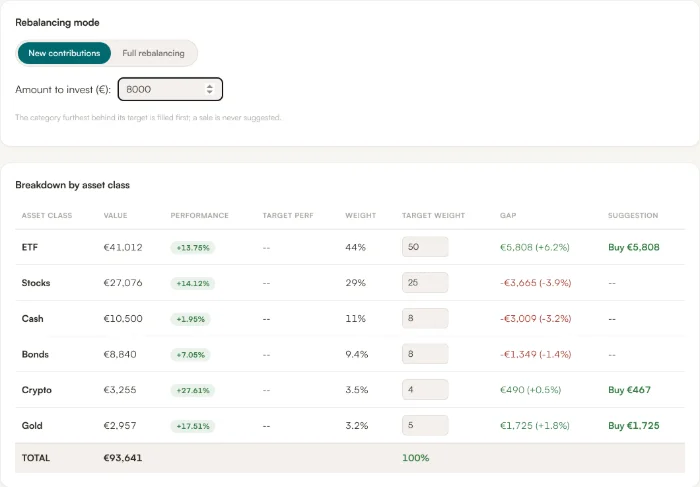
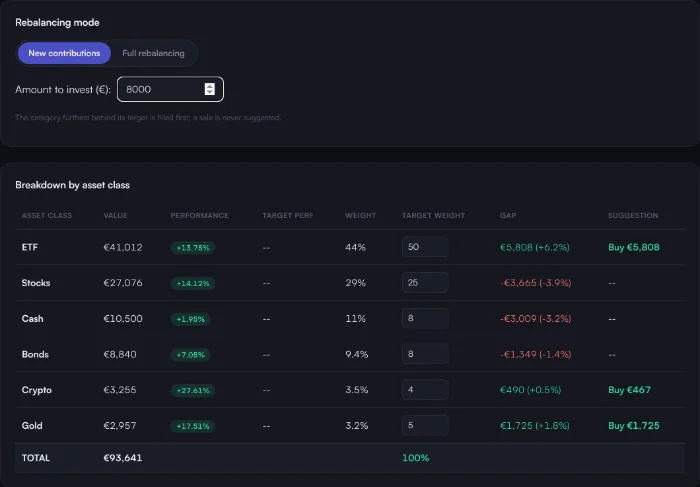
The "Rebalancing mode" panel offers both methods:
- New contributions: you enter the amount to invest, and Finapic splits it by filling the class furthest behind first, then the next one. A sale is never suggested. If the amount exceeds every gap, the surplus is split in proportion to the targets.
- Full rebalancing: for each class, Finapic shows the purchase or sale that would bring it exactly back to its target.
You can thus compare the two scenarios before deciding: see how to split a new deposit, or identify the purchases and sales needed to get back to your target allocation.
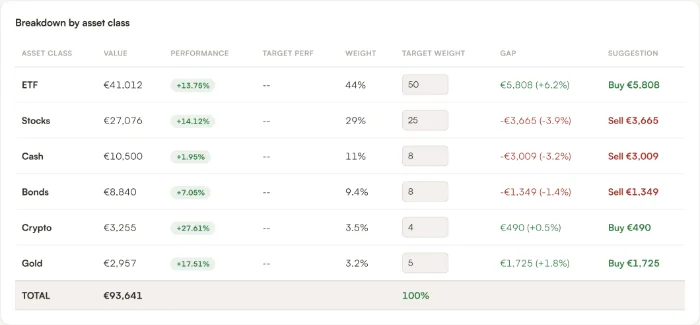
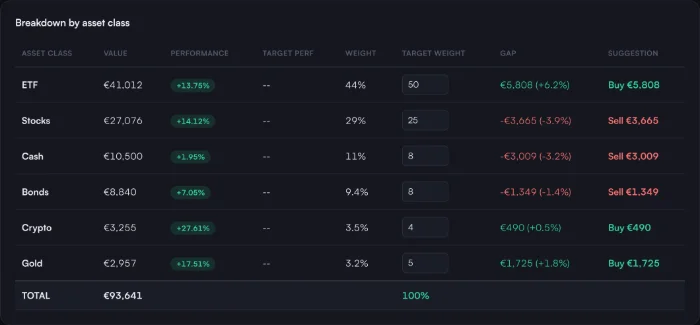
These amounts are a calculation, not a recommendation: they translate into euros the allocation you set yourself. Finapic says neither what to buy nor when; it measures the gap with your plan.
Above the tables, tabs also let you look at a single class: in the ETF tab, for instance, the breakdown is by tracked index (MSCI World, emerging markets…), and each target is a share of the class.
What about sectors and zones?
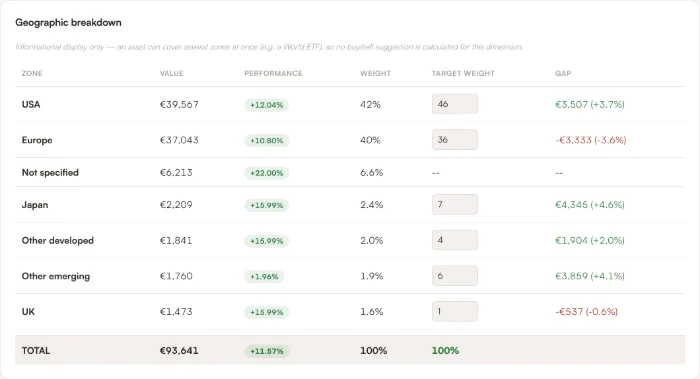
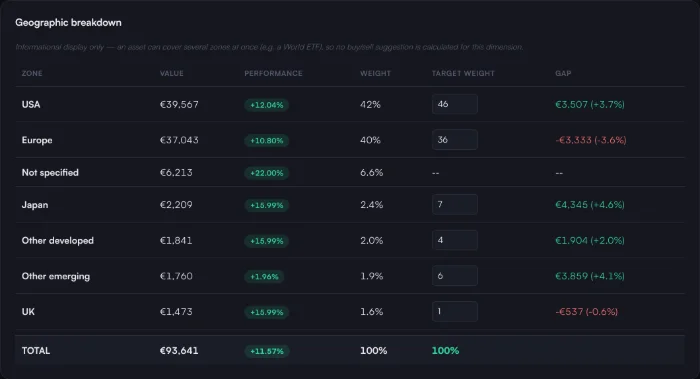
The same page shows the breakdown by sector and by geographic zone, with targets and gaps. But it suggests no purchase or sale for those, on purpose: an MSCI World ETF covers the United States, Europe and Japan, technology and health care, all at once. You can't "buy Europe" without buying something else too.
In other words, one holding can be exposed to several sectors and several zones at the same time. So a buy or sell suggestion can't always be attributed to a single zone or a single sector.
In the fictional portfolio, the United States weighs 42% against a 46% target, and Europe 40% against 36%. The gap tells you where you stand; which investment closes it is your decision.
To see what your ETFs really hold, zone by zone and sector by sector, the guide What an ETF portfolio really holds is devoted to it.
Finapic calculates and displays your portfolio's indicators; it never recommends buying or selling.
Frequently asked questions
How often should I rebalance?
There is no single rule. Some investors rebalance on a fixed date (once a year, for instance), others only when a gap exceeds a threshold they've set. Rebalancing with contributions happens with every deposit.
Should my savings account count in the allocation?
It's your choice. Counting it gives a view of all your financial savings, emergency fund included; leaving it out gives the allocation of the invested part only. In Finapic, the Accounts filter lets you look at either.
Does rebalancing improve returns?
Not necessarily. Its aim is to keep the level of risk you chose. Selling what rose to buy what rose less can reduce returns as well as support them, depending on what markets do next.
Why can selling cost me tax?
Outside a tax-sheltered account, a sale at a gain is generally taxable. Rebalancing with contributions avoids that cost, since it sells nothing.
Can you rebalance a portfolio without selling?
Yes. You can use new deposits to strengthen the asset classes that are below their target allocation. This closes the gaps gradually without selling the holdings you already own. It does, however, require you to keep adding money to the portfolio, and it can take longer than a full rebalancing.
Stay on the course you set
A well-allocated portfolio isn't necessarily one where every holding moves the same way. It's one whose allocation stays consistent with your goals and the level of risk you chose.
Set your targets, track your gaps and see where your next deposit should go, from your own operations.
Going further: track your real equity savings account performance · compare your portfolio to the MSCI World · back to the Finapic home page